
Choosing a kids' allowance app in Canada
Choose an allowance app using current Canadian fees, features and privacy information. See transparent criteria and Monty's publisher disclosure.
By Mark Sharma · October 7, 2026
Short answer: First decide whether you want an app that moves real money (with a card your child can spend) or one that helps your child practise decisions while the money stays as cash or in a bank account. Then compare cost, ages, what your child controls, what you control and how the app handles your family's data.
Disclosure: this guide is published by Monty, which makes one of the apps discussed below. We've tried to compare fairly. We include other products, say what they do well, and give the date we checked them. Product details were checked on each provider's own website on 7 October 2026. Prices and features change, so confirm current terms before you sign up.
How we compare apps
We use six questions. They work for any app, including ours.
- Does it hold real money? Card apps hold money your child can spend. Tracker and habit apps record money that lives somewhere else.
- What does it cost, all in? Look past the monthly fee. Check card fees, replacement fees, foreign transaction fees and what happens after a trial.
- Who is it for? Check the minimum and maximum ages, and whether younger siblings can join the same account.
- Who makes the choices? Some apps let parents set splits and rules. In others, the child decides within limits. Learning happens when your child does the choosing.
- Does it prompt reflection? Spending is easy to automate. Looking back on a purchase ("was it worth it?") is the part that teaches.
- Where does your family's data go? Read the privacy policy. Check what's collected about your child, where it's stored and whether it's used for advertising.
Features and money-handling boundaries
Checked 7 October 2026. Only apps we could verify as available in Canada are named.
| Mydoh (from RBC) | JA Money card (Neo Financial with JA Canada) | Monty | |
|---|---|---|---|
| Type | Prepaid card app | Card for teens | Money-habit app (no card) |
| Holds real money | Yes: prepaid Visa issued by RBC; kids can only spend what's loaded | Yes: comes with Neo's Everyday account; Neo lists interest on balances | No: records cash or transfers; doesn't connect to bank accounts |
| Ages | 6–17 | 13–17 | Built for families with kids in K–8 |
| Parent tools | Load money from most Canadian bank accounts, purchase notifications, lock the card, set tasks and weekly pay days | Not described on Neo's youth page | Set the allowance, family money rules and what money has to cover |
| Child tools | Savings goals, budgeting, pay in stores and online; Apple Pay from age 13 | Interest on balances, JA Knowledge Hub learning content | Choose Spend, Save or Give each week, saving goals, review purchases |
| Family size | Up to 2 parents and 5 kids | Per teen | Up to 5 child profiles |
What each one is good for:
- Mydoh suits families who want a child to spend real money in stores and online, with parent visibility, from age 6.
- JA Money suits teens 13–17 who are ready for their own card, with learning content from Junior Achievement.
- Monty suits families who want their child to practise choosing and reflecting, and who are happy to keep using cash or a bank account for the money itself.
These aren't mutually exclusive. A card app or a kids' bank account handles payments, and a habit app handles the weekly conversation. See Kids' bank account or money-habit app: what helps when?.
Canadian fees and offer terms
| Monthly fee | Other costs to check | Trial | |
|---|---|---|---|
| Mydoh | No monthly fee | A custom "Mydoh by Me" card costs $6.99 and needs a "Mydoh Family" account. | Not applicable (no fee) |
| JA Money card | No account fees, per Neo's youth page | Neo changed several fees and rates on 1 October 2026. Check the current fee schedule. | Not applicable |
| Monty | $10/month, or $99/year. Founding Families: $149 once (limited spots) | None. Every plan has every feature. | First four Monty O'Clocks free; no credit card needed |
Privacy and parent involvement
Before you or your child signs up for any app, check:
- What it collects about your child: name, birthdate, photo, location, purchase history.
- Where it's stored: Canada or elsewhere, and which service providers receive it.
- Advertising: whether your family's data is used for ads or sold.
- Deleting: whether you can delete your child's profile and data yourself.
For Monty: we collect a child's first name, birthdate or grade level and an avatar. A parent or guardian creates every child profile. Our database is hosted in Canada (Montreal). Some of our service providers, such as payments and email, process data outside Canada; our privacy policy lists each one and what it receives. We don't use family data for advertising and we don't sell it. Monty never sees bank account or card numbers.
Monty's role in this comparison
We make Monty, so read this guide with that in mind. Here's where Monty fits, and where it doesn't:
- Monty doesn't move money. If your child needs to pay online or in a store, you'll still want a card or a bank account.
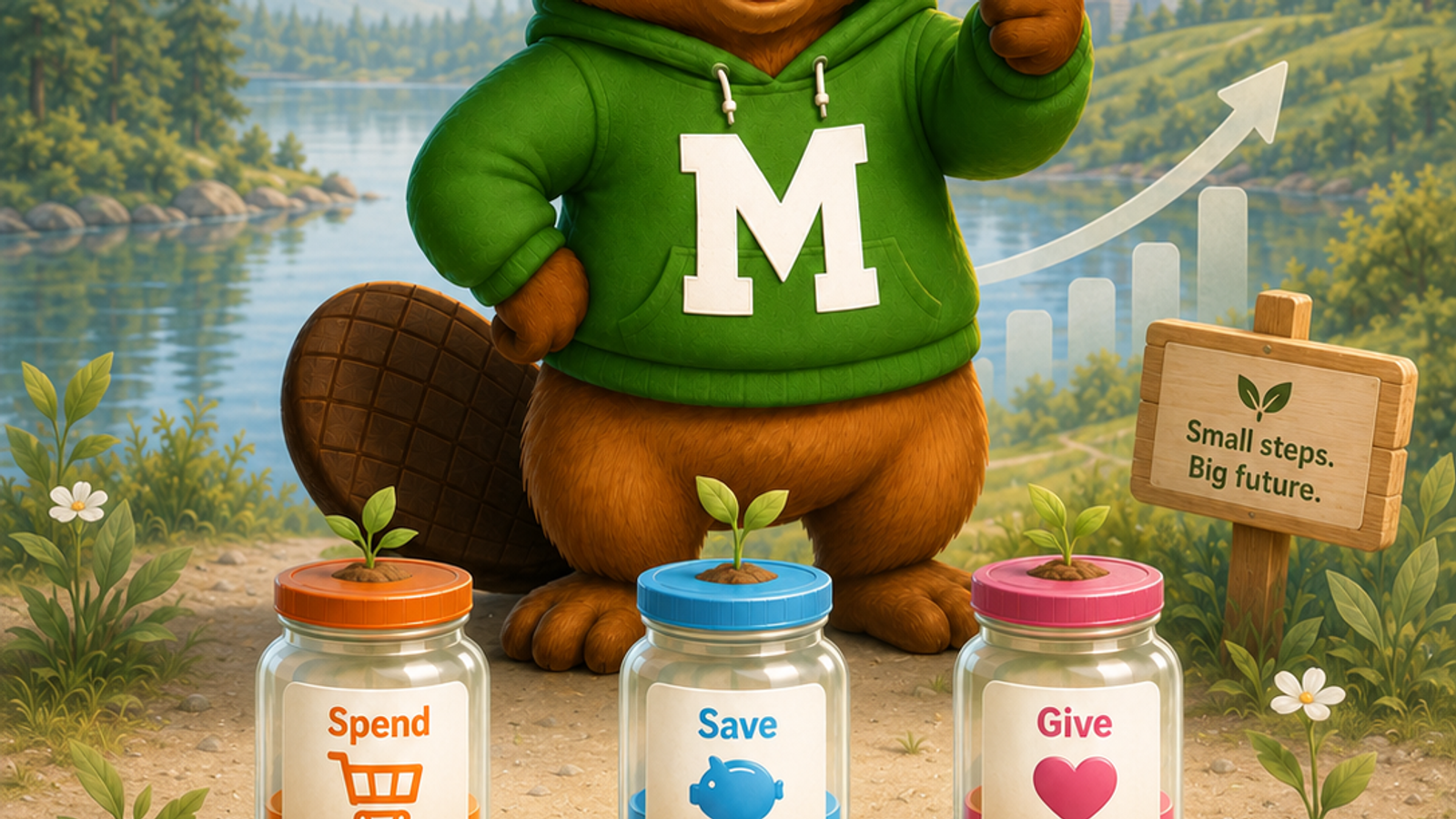
- Monty is about the weekly decision. Each Monty O'Clock takes about two minutes. Your child chooses Spend, Save or Give, works toward goals, and looks back at what they bought. You set the boundaries; your child makes the choices.
- Monty costs money after the trial. The card apps above don't charge a monthly fee. Decide whether the weekly practice is worth $99 a year to your family. The four free Monty O'Clocks are there so you can find out first.
Questions parents ask
Is there a free allowance app in Canada?
Yes. Mydoh has no monthly fee, and the JA Money card has no account fees per Neo's youth page. Both are card products that hold real money. Cash jars and a notebook also cost nothing.
What age should a child get an allowance app?
It depends on what the app does. Mydoh starts at 6 and JA Money at 13. Habit tools can start as soon as your child can choose between two things. The Financial Consumer Agency of Canada says the goal of an allowance is learning to manage money, and that "how much you give is less important than the goal."
Sources
- Financial Consumer Agency of Canada, Teaching children about money, checked October 7, 2026
- Financial Consumer Agency of Canada, Prepaid cards: know your rights, checked October 7, 2026
- Mydoh (RBC), Mydoh, checked October 7, 2026
- Mydoh (RBC), Mydoh pricing, checked October 7, 2026
- Mydoh (RBC), Smart Cash Card, checked October 7, 2026
- Neo Financial, Neo for youth, checked October 7, 2026
- Neo Financial, Eligibility requirements for the Neo products, checked October 7, 2026
Take the Monty O'Clock Monthly Challenge!
Your first four Monty O'Clocks are free. No credit card needed.