
Money habitsOct 23, 2026
Should Kids' Allowance Be Tied to Chores?
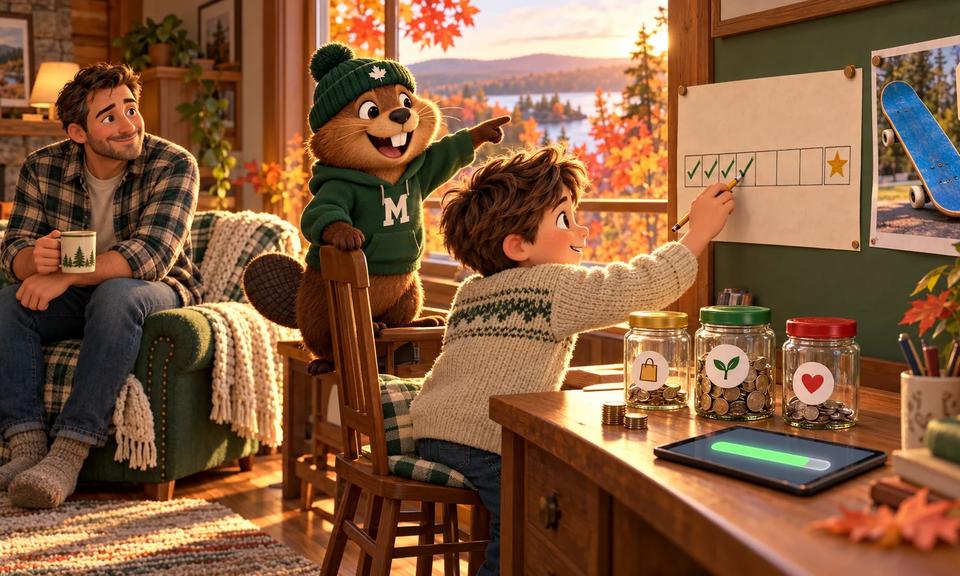
Three ways families handle allowance and chores, compared: a separate allowance, a base plus paid extra jobs, or pay per chore. Pick one and set it up.
Grades: All grades K–8

Practical, judgment-free guidance for Canadian parents. Start with a two-minute check-in, then pick your child’s grade.
Jump to your child’s grade
No money this week? Do the check-in anyway. Look at the goal and talk about one choice coming up.
Starting points, not rules. Every child is different, so use the stage that fits your child, not just their grade.
Make money something they can hold.
You do the reading and most of the counting. Real coins in a clear jar turn money into something your child can see. Offer one choice at a time, then look at what is left together.
Try this week
At the store, offer one small thing your child can pay for with their own coins. At home, count what is left in the jar together.
In Monty:Spend, Save, Give jars
12 guides for Kindergarten
Money habits
Should Kids' Allowance Be Tied to Chores?
Oct 23, 2026
Money habits
How Long Until I Can Buy It? A Savings Goal Planner for Kids
Oct 23, 2026

Money habits
Spend, Save, Give, Grow: Let Children Choose Each Dollar's Job
Oct 16, 2026

Money habits
How to Help Kids Save for Something They Want
Oct 16, 2026
Compare two wants.
Children this age can weigh one thing against another. Help them divide their money between spending, saving and giving, but let the split be theirs. Keep goals a few weeks away, and ask them to tell you about what they bought.
Try this week
Before shopping, ask: "If you could only pick one of these two, which would it be, and why?" Afterwards: "Was it worth it?"
In Monty:Saving goals
12 guides for Grades 1–3
Money habits
Should Kids' Allowance Be Tied to Chores?
Oct 23, 2026
Money habits
How Long Until I Can Buy It? A Savings Goal Planner for Kids
Oct 23, 2026
Money habits
Spend, Save, Give, Grow: Let Children Choose Each Dollar's Job
Oct 16, 2026
Money habits
How to Help Kids Save for Something They Want
Oct 16, 2026
Plan for something bigger.
Goals can now stretch over months. Talk about trade-offs: buying one thing means waiting longer for another. Let them revisit their split when a goal changes, and compare what something cost with how much they actually enjoyed it.
Try this week
Work out a goal together. A $20 item takes 10 weeks at $2 a week, starting from zero, if the price stays the same. If sales tax applies, figure out the final total first.
In Monty:Purchase reviews
11 guides for Grades 4–6
Money habits
Should Kids' Allowance Be Tied to Chores?
Oct 23, 2026
Money habits
How Long Until I Can Buy It? A Savings Goal Planner for Kids
Oct 23, 2026
Money habits
Spend, Save, Give, Grow: Let Children Choose Each Dollar's Job
Oct 16, 2026
Money habits
How to Help Kids Save for Something They Want
Oct 16, 2026
Practise with the money they can’t see.
Spending moves into apps, games and online stores, and some costs repeat every month. Hand over more responsibility, and start talking about earning: babysitting, odd jobs and, eventually, a first paycheque.
Try this week
Find one subscription or in-app purchase together. What does it cost each month, and across a whole year?
In Monty:Spending choices
11 guides for Grades 7–8
Money habits
Should Kids' Allowance Be Tied to Chores?
Oct 23, 2026
Money habits
How Long Until I Can Buy It? A Savings Goal Planner for Kids
Oct 23, 2026
Money habits
Spend, Save, Give, Grow: Let Children Choose Each Dollar's Job
Oct 16, 2026
Money habits
How to Help Kids Save for Something They Want
Oct 16, 2026
Three ways families handle allowance and chores, compared: a separate allowance, a base plus paid extra jobs, or pay per chore. Pick one and set it up.
Grades: All grades K–8
Enter the price, what your child has saved and what they'll put aside each week to see how many weeks until they can buy it, with your province's tax.
Grades: All grades K–8
How to set up Spend, Save, Give and Grow jars, why there's no perfect split, which limits are yours, and how to look back at what each choice did.
Grades: All grades K–8
Help your child pick a goal they care about, work out how long the wait is, check in each week and decide what happens if they change their mind.
Grades: All grades K–8

Calm things to say before you shop, when your child asks for something and afterward, so "Can you buy this?" becomes "Do I have enough, and is it worth it?"
Grades: All grades K–8

How much allowance to give your child, age by age: an illustrative range, what each age might cover, and how to check it fits your family's budget.
Grades: All grades K–8

Start your child's first allowance in six steps: find the money, agree what it covers, pick a payday, fit chores in, talk on payday, adjust after a month.
Grades: All grades K–8

Simple questions to ask after your child buys something, how to handle regret without shame, and a next-week follow-up that turns purchases into practice.
Grades: All grades K–8

A practical Canadian guide: give your child a small amount to manage, agree what it covers, and talk about their choices each week. Grade-by-grade ideas.
Grades: All grades K–8
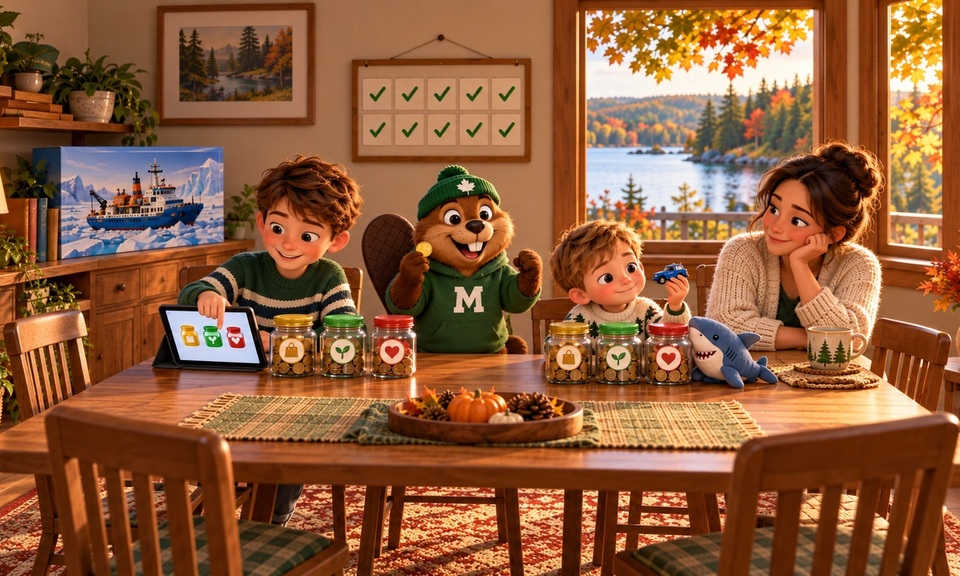
From putting back Hot Wheels to calculating how long it would take to refill a Spend Jar, here's what happened when two kids started practising real money decisions every week.
Grades: KindergartenGrades 1–3

Compare cash, kids' bank accounts and money-habit apps. Understand their different jobs and choose tools that fit your family's needs.
Grades: All grades K–8

Choose an allowance app using current Canadian fees, features and privacy information. See transparent criteria and Monty's publisher disclosure.
Grades: All grades K–8
Four Monty O'Clocks, your kid's real money, and two minutes a week together.

Want to know how Monty works for you? Monty for parents →