
Short answer
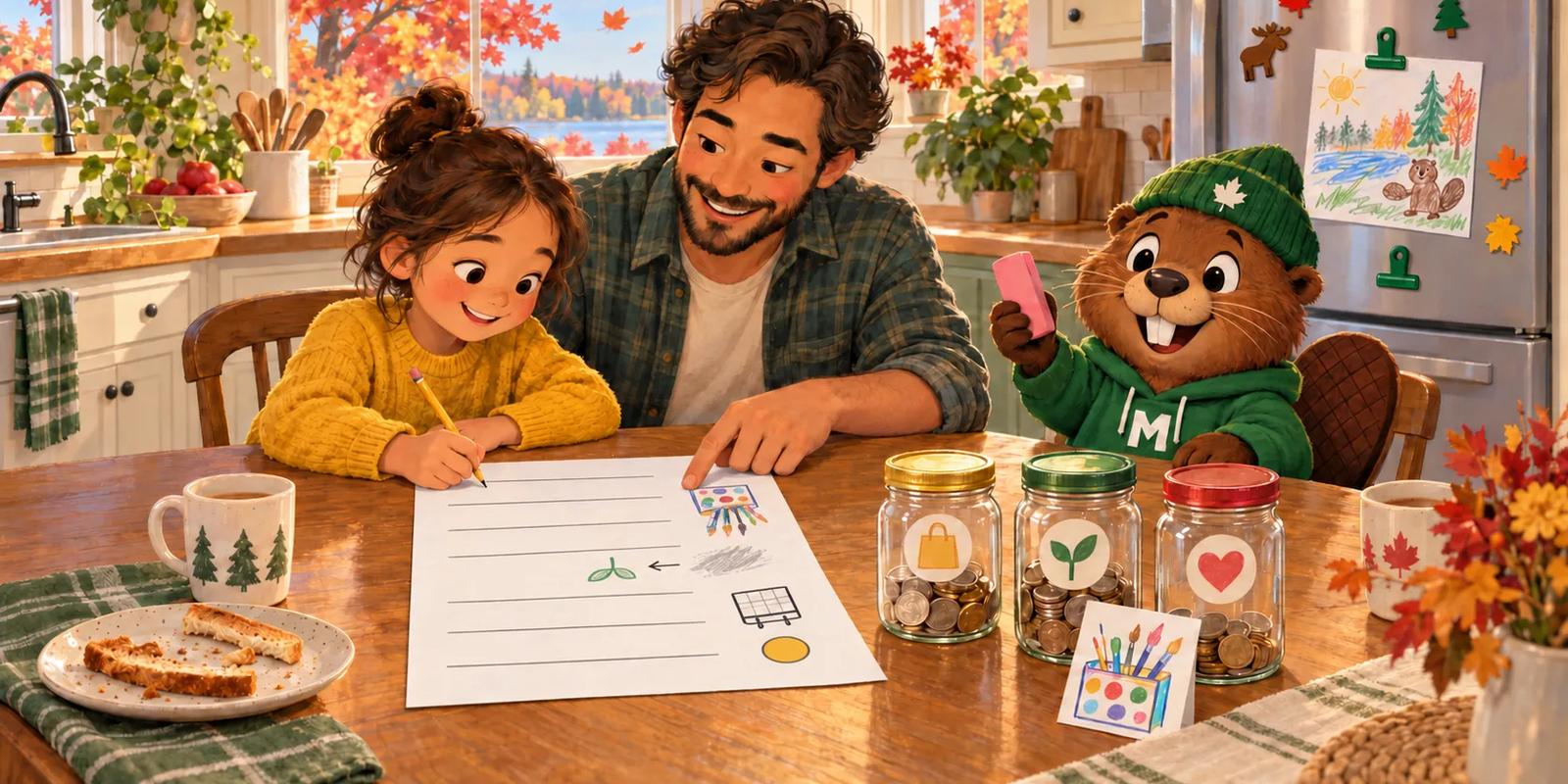
An allowance agreement is one short page you and your child fill in together before the first payday. It says how much money comes in and when, what their money covers, what you keep paying for, what needs a yes from you first, and when you'll talk about it. It's a starting point, not a promise: update it whenever something changes. Fill it in on this page, then print it or email it to yourself.
An agreement makes that possible: your child can only manage money when they know which money is theirs and what it's for.
Start with the family question
Before you fill anything in, ask yourselves one question: what do we want this money to teach?
For most families, the answer is some version of "making choices with a limited amount." That answer shapes the rest:
- If it's about choices, the agreement should give your child real ones, inside limits you're comfortable with.
- If it's also about earning, decide how chores fit before you start. See whether allowance should be tied to chores.
- If you haven't picked an amount yet, start with allowance by age.
Then ask your child: "What would you like to do with money of your own?" Their answer tells you what goal to put in the plan, and it makes the agreement theirs as well as yours.
Fill in the agreement together
Go through the eight parts below with your child, fill in what you can and ask the question under each part. Younger children can draw or point while you type. Your agreement appears underneath, ready to print or email. Anything you leave empty stays a blank line to fill in by hand.
Don't write a fixed split into the agreement. A birthday coming up, a goal that's nearly reached or a week with nothing to buy all change what makes sense. Choosing again each payday is the practice, and the reason behind each choice matters more than the numbers.
Fill in what you can together. Anything you leave empty stays a blank line to fill in by hand. Your answers stay in this browser; nothing is sent to Monty.
Our money plan
A starting point, not a promise. We’ll change it when things change.
- Money in
- ________ gets $________ every week, on ________.
- Gifts and money earned from extra jobs go into the plan too.
- Each dollar gets a job
- Each payday, ________ decides how to split the money into Spend, Save and Give, with a parent there to help. The split can be different every time.
- Right now ________ is saving for: ________ ($________).
- What we pay for, what your money pays for
- A parent keeps paying for: food, clothes, school supplies, health and safety, and ________.
- ________’s money pays for: ________.
- Ask first
- ________ asks a parent before: in-app or online purchases and anything over $________.
- When Spend runs out
- When the Spend money is gone, there are no more extras until the next payday.
- Essentials never depend on ________’s balance.
- Chores and extra jobs
- Everyday contributions (not paid): ________.
- Paid extra jobs, if any: ________.
- Our check-in
- We talk about money every ________ for a few minutes: what came in, the split, goals and anything bought.
- When we’ll change this
- We’ll look at this agreement again on ________.
- Either of us can ask to change it at a check-in when something changes: a new goal, a birthday, a new expense, or money being tighter for a while.
- Made together on: ________.
On your phone? Email it to yourself, then print it from your computer.
You can print the agreement or email it to yourself and print it from your computer, but you don't need a perfect copy. Put it on the fridge or somewhere else you'll both see it. What matters is that you can both find it when a question comes up.
Try a practical example
Sam is seven and in Grade 2. Here's the agreement Sam and a parent filled in:
- Money in: $5 every week, on Saturday after breakfast. Birthday money goes in the plan too.
- Jobs for each dollar: Sam chooses the split each payday. Right now Sam is saving for a $25 art kit.
- We pay for / Sam pays for: we keep paying for food, clothes, school supplies, swimming lessons and birthday party gifts for classmates. Sam's money pays for treats, stickers and small toys.
- Ask first: anything on the tablet, and anything over $5.
- When Spend runs out: no extras until Saturday.
- Chores: setting the table and putting toys away. No paid jobs yet.
- Check-in: Saturday after breakfast, right after payday.
- Change it: first Saturday next month, or sooner if something changes.
The first week, Sam put $3 in Save, $1 in Spend and $1 in Give. At that rate, the art kit would take 9 weeks before tax; with Ontario's 13% HST it's $28.25 and 10 weeks. (Work out your own child's goal with the savings goal planner.) When Sam asked for a slushie on Wednesday with $1 left in Spend, the answer was already on the fridge.
The next week was different. A friend's birthday party was coming up, so Sam put $4 in Spend and only $1 in Save. The art kit got a bit further away, and Sam knew why. A few weeks later, Sam's grandparents sent $10 and Sam put most of it in Save. Nothing in the agreement had to change. The split was Sam's call each time; only the timeline moved.
In the second month, Sam started asking for a snack after every swimming lesson. At the Saturday check-in, they changed parts 1 and 3 together: the allowance went up to $6, and snacks after swimming moved to Sam's list.
Adapt it to your child and family
These are starting points. Adjust them to your child.
- AgreementUse pictures for each part and keep to three: money in, the jars, and the check-in day. You write; they draw their goal.
- AgreementAll eight parts, short. Read it aloud together. Keep the "ask first" list to two or three things.
- AgreementYour child writes some of it. Add tax to the goal price and decide whether there are paid extra jobs.
- AgreementHand over a category, such as gifts for friends' birthdays, and add it to part 3. Consider paying every two weeks.
- AgreementYour child drafts it and you edit together. Add online and in-game spending to part 4, and consider a monthly payday.
- IFMore than one child
- Write one agreement for each. Amounts, goals and the "ask first" list can differ by age, even if the check-in is at the same time.
- IFTwo parents or two homes
- Agree on the page between you first, then go through it with your child. Whoever pays on payday follows the same page.
- IFYour own money situation changes
- Change the agreement too. If you need to pay less for a while, say so at a check-in, explain it simply, and write in the new amount. A smaller allowance that still comes on payday is easier to plan around than the old amount paid some weeks and not others.
A regular home for the allowance — two minutes a week.
The agreement works when you come back to it. Monty O'Clock, the two-minute weekly check-in, is where that happens. You set each child's allowance amount and schedule, and the day Monty reminds you to sit down together. Your child decides the Spend, Save and Give split every time, checks their goals and reviews what they bought. If a purchase or a bonus needs explaining, you can add it with a reason they can see.
Monty is the record
- Tracks each jar, allowance and gifts
- Weekly, bi-weekly or monthly
- Gifts and bonuses, split by your kid
Not the bank
- Doesn’t hold money
- No card issued
- Never connects to your bank
First four Monty O’Clocks free, every feature, no credit card. Then $10/month or $99/year, plus applicable tax.
See what parents set and what stays the child's decision, how the family workspace fits more than one child or parent, or read how Monty O'Clock works. For the setup steps, see how to start an allowance.
Questions parents ask
What should an allowance agreement include?
How much and how often, how the money is split, what you pay for and what their money pays for, what needs a yes first, what happens when Spend runs out, how chores fit, when you check in and when you'll review it. The eight parts above cover all of it on one page.
Is an allowance contract a good idea for kids?
Yes, if it can change. Signing it together shows you both agree to it, and your child takes it more seriously when their name is on it. A family money plan needs to change often, so when it does, write the new version and sign it again. Letting your child help write it keeps it a conversation rather than a set of terms.
Should my child commit to a set split, like half to Save?
No. Situations change from week to week, and a fixed split is hard to keep. Let your child choose the split each payday and ask why. Over time, you'll both see their pattern, and that's more useful than a rule.
What if my child doesn't follow the agreement?
Go back to the page together. If a part keeps causing arguments, it may be the agreement that needs changing, not your child. Change one thing at a time, at a check-in, so nothing changes by surprise.
Do I need a printable allowance worksheet?
No. Fill in the agreement on this page and print it, or email it to yourself and print it from your computer. A copy in your phone's notes works too. Use whatever you'll actually look at together.
When should we change the agreement?
Whenever something changes: a new goal, a birthday, a new school year, a new expense your child takes on, a change in what you can pay, or when payday starts to feel like a debate. Check it once after the first month even if nothing has.
Sources (5)
- Teaching children about money — Financial Consumer Agency of Canada · checked Oct 23, 2026
- Parent controls — Monty · checked Oct 24, 2026
- Family workspace — Monty · checked Oct 24, 2026
- Monty pricing — Monty · checked Oct 24, 2026
- How Monty O'Clock works — Monty · checked Oct 24, 2026
Monty publishes this guide. Financial education, not financial advice.