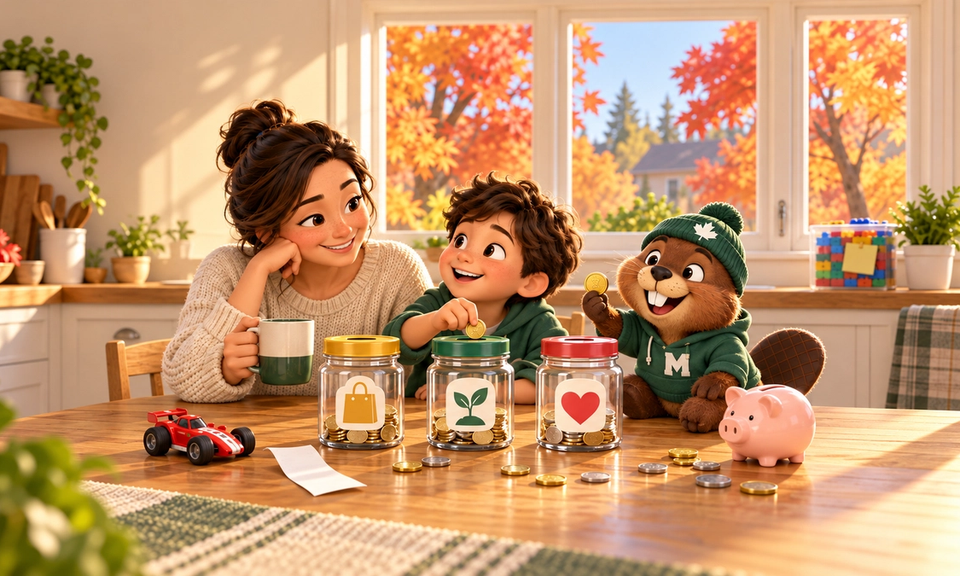
What to Say When Your Child Keeps Asking to Buy Things
Calm things to say before you shop, when your child asks for something and afterward, so "Can you buy this?" becomes "Do I have enough, and is it worth it?"
By Mark Sharma · October 16, 2026
Short answer: Children keep asking because asking costs them nothing: the decision, and the money, are yours. Give them some money of their own, agree before you go what you'll buy and what comes from their money, and when they ask, turn "Can you buy this?" into "Do you have enough, and is it worth it?" When the answer is no, say it calmly with a reason, and come back to it later.
Constant requests can make every errand feel like a negotiation. You don't fix that by saying no more often. You fix it by changing who makes part of the decision.
Why the asking doesn't stop
When a child asks, "Can you buy this for me?", the whole decision sits with you. If you say yes, they get it. If you say no, they've lost nothing and can ask again next time. Asking is free.
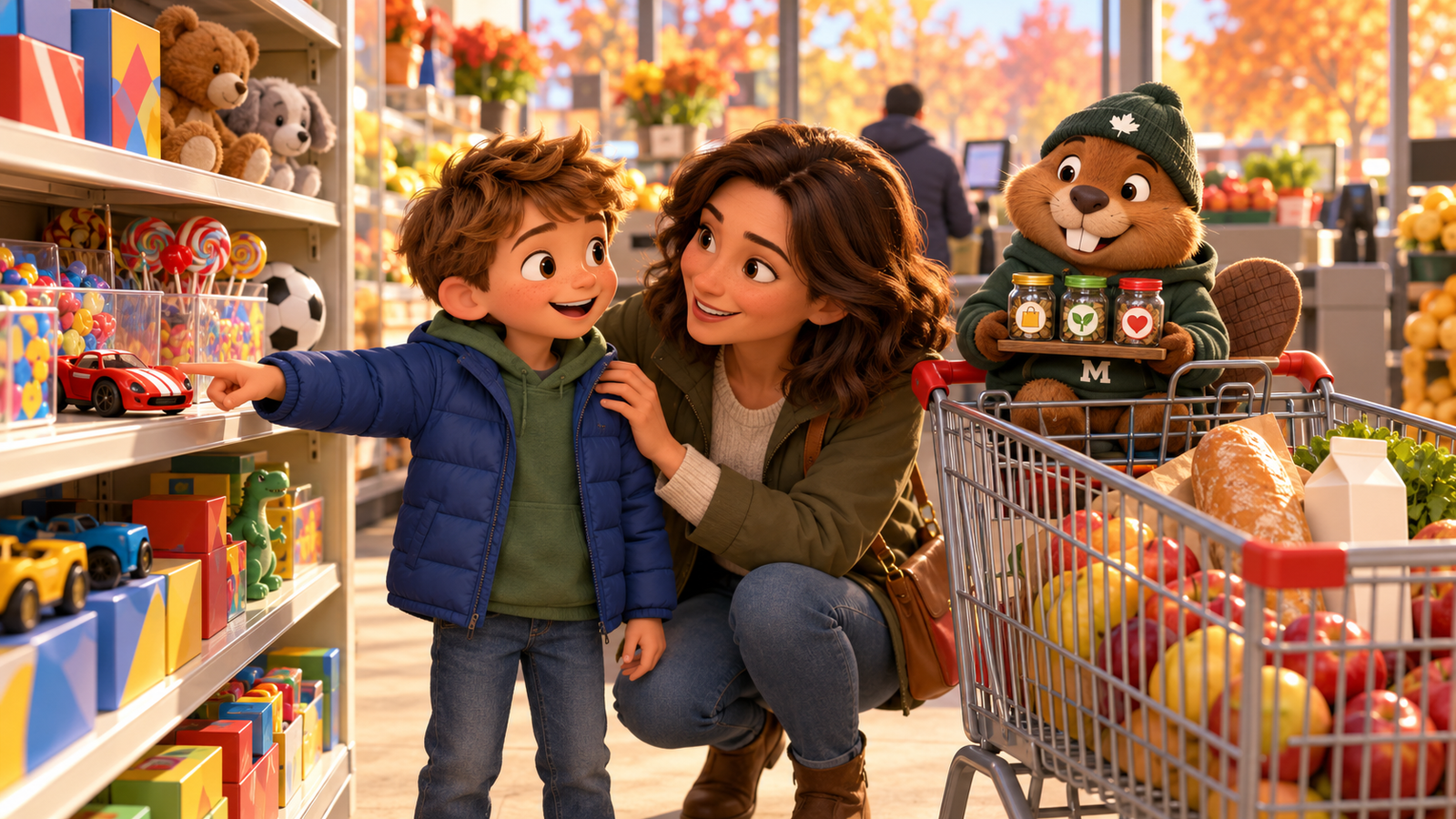
Before my boys had money of their own, that was the usual question. Less than a week after our first Monty O'Clock, my older son asked me in a grocery store, "Do I have enough money in my Spend Jar to buy a Hot Wheels car?"
That's a different question. "Can you buy this?" puts the decision on the parent. "Do I have enough?" makes the child responsible for part of it. You don't disappear: your role shifts from gatekeeper to coach.
That shift needs two things in place first:
- Money that's theirs to decide about, such as an allowance. See how to start an allowance and how much to give at each age.
- An agreement about what it covers. Treats and small toys come from their money. Food, clothes and other needs come from yours.
The Financial Consumer Agency of Canada (FCAC) suggests helping children understand the difference between needs and wants, and spending on needs first. An agreement makes that line visible in the store.
Before you go
Most aisle arguments can be settled in the car. Before a shopping trip, take a minute to agree on the plan:
- "We're here for groceries and a birthday gift for your cousin." Name what the trip is for.
- "I'm not buying toys or treats today." Say it before anyone sees the toy aisle.
- "If you see something you want, you can check your Spend Jar." Remind them they have their own money, and how much.
- "If you're not sure, we can take a picture and think about it." Give them a way to say "not yet" before they're excited.
The FCAC also suggests talking while you shop about how you decide what to buy, and why you did or didn't buy something on sale. When your child hears you weigh a choice out loud, they learn how it's done.
When they ask in the store
When your child holds something up, try these steps in order. You won't need all of them every time.
- Notice it. "That does look fun." You're not agreeing to buy it. You're showing you heard them.
- Ask whose money it is. "Is that a Spend Jar thing?" If it's on your list, like milk or fruit, you'll buy it. If it's a want, it comes from theirs.
- Check together. "How much is in your Spend Jar? How much is this, with tax?"
- Name the trade-off. "What would buying this do to your goal?" or "Is this a need, a want or a maybe?"
- Let them decide, if it fits your agreement. Then it's their choice, and yours to respect.
On that first grocery trip, I told my older son he had enough. Then I asked whether another car was worth delaying his giving goal or his LEGO goal by a few dollars. He looked through the cars, decided there wasn't one he wanted enough and walked away. I didn't tell him no. He decided no.
My younger son brought a Hot Wheels car toward the checkout. I reminded him it would come from his Spend Jar. He thought about it, then went back and put it away. The toy wasn't forbidden. The trade-off was simply visible.
Not every decision should end with putting it back. Less than a week later, my older son checked his Spend Jar for a PEZ dispenser, decided it was worth it and we bought it with his Spend money. Spending is part of managing money. The skill is noticing the decision.
When they want to spend it all
Sometimes your child has the money and wants to spend all of it. If it fits your agreement, it's their call. You can still help them see what comes next:
- "How long will it take to refill?" Divide the price by what they add to Spend each week.
- "What happens next time you want something?" Remind them you won't buy those extras when their jar is empty.
- "Let's look at what you already have." A toy that feels urgent in the store can look different next to the ones at home.
One day, my older son wanted to spend the rest of his Spend Jar. At the previous Monty O'Clock he'd put only $1 into Spend because his LEGO goal mattered more. At that rate, replacing the money would take about 45 weeks. I told him it was his choice and asked whether he wanted to find out what an empty Spend Jar feels like the next time he really wanted something. He decided to keep the money.
I didn't say, "No. Save your money." The question was: you chose your goal; if you spend everything today, what does that mean tomorrow? He made the final decision. His younger brother sat beside him through the whole conversation, listening.
When they ask again and again
Knowing the rule and applying it while excited are two different things. Fifteen minutes after that conversation, we ended up in another toy store. Both boys were overstimulated and picked things up one after another: "Can I buy this from my Spend Jar?"
So we tried something new: "Let's take a picture. If you still want it next month, we can talk about it again. Your Spend Jar needs a break."
A picture gives the want somewhere to go. It isn't no forever; it's not today. Eventually, it clicked. Kids still need coaching, and that's fine.
Other ways to slow things down:
- Agree on a waiting rule, such as one day for small things or one week for bigger ones.
- Keep a wish list on paper or in your phone. Read it together later.
- Move the decision to a calmer time: "Let's talk about it at Monty O'Clock."
Saying no calmly
You're still the parent. Sometimes the answer is "not today", even when your child has the money: it isn't safe, it breaks a family rule, or you don't have time. When that happens:
- Give the reason once, tied to your agreement. "In-app purchases need my OK first, and I'm not saying yes today."
- Don't negotiate in the aisle. "I've heard you. We can talk about it at home."
- Stay kind and brief. Your child can be disappointed. You don't need to fix the feeling or change the answer.
- Avoid "That's a waste of money." Help them form their own judgement instead.
My older son once wanted a squishy toy at a smoothie shop. We said not today. "I've got money in my Spend Jar!" He was right, he did. He also had a drawer at home full of similar little toys. So we said: clean out that drawer and make room, and if you still want it afterward, we'll come back. We went home. He finished his drink and forgot about the toy.
A Spend Jar isn't a licence to buy anything, anytime. It changes the conversation; it doesn't remove you from it.
If a new limit is needed, say so plainly and add it to your agreement afterward, so your child knows which choices are theirs next time.
The calm follow-up
The most useful conversation often happens later, when no one's excited. That evening, or at your next weekly check-in, ask:
- "What did you want today? Do you still want it?"
- "What would it take to get it?" If it's still important, it can become a savings goal. See how to help kids save for something they want.
- "How did it feel to walk away?" or "Are you glad you bought it?"
If they bought something, come back to it a week later. Was it worth it? Would they buy it again? Was it worth it? has questions for that conversation.
If they still want it after waiting, that tells you something. If they've forgotten it, that does too.
Adapting it by grade
These are starting points, not developmental rules. Adjust them to your child.
- Kindergarten: keep it to one question: "Spend Jar or not today?" Help them count the money.
- Grades 1–2: add the trade-off: "If you buy this, your goal takes longer." Use pictures and a short wish list.
- Grades 3–4: have them work out the price with tax and how many weeks it takes to refill.
- Grades 5–6: let them compare options and prices before deciding. Talk about sales: when a lower price is worth it, and when it isn't.
- Grades 7–8: include online stores, games and in-app purchases. Agree on what needs your OK first.
Practise it at Monty O'Clock
Monty gives these conversations a home. Your child can check their Spend Jar before asking. When they buy something, the purchase comes out of their Spend balance, and about a week later it comes back for a purchase review at Monty O'Clock, the two-minute weekly check-in. Their goals show how long a target will take at the rate they're saving.
Monty is the record, not the bank. The money stays in your account, and you make the purchases. Monty keeps track of what's in each of your child's jars. It doesn't hold money, issue a card or connect to your bank.
See how spending choices work in Monty, read our first month with Monty, or see how Monty O'Clock works.
Start the Monty O'Clock Monthly Challenge: your first four Monty O'Clocks are free, with every feature and no credit card needed. After that, Monty is $10/month or $99/year, plus applicable tax. See pricing for details.
Questions parents ask
Should I just buy it sometimes?
Yes, if it's something you'd choose to buy anyway, like a treat on a special day. Say that it's your choice, not theirs, so it doesn't blur the agreement.
What if my child has a meltdown in the store?
Keep your words short and the answer the same. Leave if you need to. Talk about it later, when everyone is calm.
What if they don't get an allowance yet?
Start with money they already have, such as birthday money, and agree what it can be used for. Without money of their own, every request still lands on you.
Can I say no if they have the money?
Yes, when it breaks your agreement or a family rule, or isn't safe. Explain the reason. If it fits the agreement, try to let them decide, even when you wouldn't buy it.
What about grandparents and gifts?
Share your approach with them. Gift money can go into your child's jars, so they still choose how to use it.
Sources
- Financial Consumer Agency of Canada, Teaching children about money, checked October 15, 2026
- Mark Sharma (Monty), Our family's money habits with Monty, checked October 15, 2026
- Monty, Spending choices, checked October 15, 2026
- Monty, How Monty O'Clock works, checked October 15, 2026
- Monty, Monty pricing, checked October 15, 2026
Take the Monty O'Clock Monthly Challenge!
Your first four Monty O'Clocks are free. No credit card needed.