Spend, Save, Give: Let Children Choose Each Dollar's Job
How to set up Spend, Save, Give and Grow jars, why there's no perfect split, which limits are yours, and how to look back at what each choice did.
By Mark Sharma · October 16, 2026

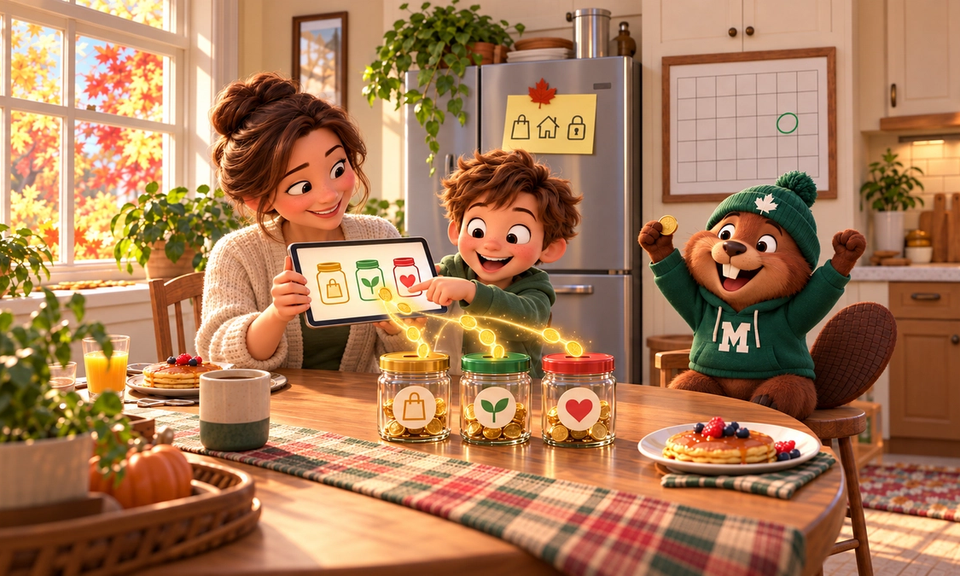
Short answer: Give your child four jars: Spend for now, Save for short-term goals, Give for others and Grow for long-term saving. Let them decide how each allowance is split. There's no perfect split. You set the limits: how much they get, what each jar is for and which purchases need your OK. They choose where each dollar goes. Then, each week, look back together at what those choices made possible.
Jars won't teach much if a parent decides the split. The learning comes from your child choosing, living with the result and choosing again next week.
What each jar is for
Each jar has a recommended job. Your child decides how much goes in each one; the job tells them what that money is for.
- Spend: money for now. Small things they want this week or soon, such as a treat, a small toy or a game. It's fine for Spend to run out; that's what it's for.
- Save: short-term goals. Something they want in the next few weeks or months, such as a LEGO set or a scooter. Save works best with one goal they can picture.
- Give: money for others. A cause, a charity, a friend or a family member. It can wait until your child finds something that matters to them.
- Grow: long-term saving. Money for something a year or more away, or for a goal they haven't chosen yet. It's money they plan to leave alone for a long time.
The difference between Save and Grow is time. If your child can picture getting it soon, it's Save. If it's a year or more away, or they don't know yet, it's Grow. A dollar a week in Grow is $52 after a year.
Grow is saving, not investing. The money doesn't earn anything; it simply waits and adds up as your child puts more in.
The Financial Consumer Agency of Canada (FCAC) suggests children use jars or envelopes to divide up their money: one to spend, and one or more to save, with a separate container for each savings goal. Save and Grow are two kinds of saving; Give is a job many families add.
Separate jars make a choice visible. One pile of money has no plan. Four jars show your child, at a glance, what they've decided their money is for.
My boys started with three jars, Spend, Save and Give, so the family examples below come from then.
Setting up the jars
You don't need anything special to start:
- Four clear jars or envelopes, labelled Spend, Save, Give and Grow. Clear jars let younger children see the money add up.
- A weekly time to split new money, ideally right when the allowance arrives. Five minutes at the kitchen table is enough.
- Money that's theirs, such as an allowance. See how to start an allowance and how much to give at each age.
- A goal for Save, if they have one, and one for Grow if they know it. Write it on the jar, or on a sticky note beside it.
Give the allowance in coins or small bills so it can actually be divided. Seven loonies are easier to split than a $5 bill and a toonie.
Gifts and birthday money can go through the same split. Your child decides when the money arrives, the same as with an allowance.
There's no perfect split
Parents often ask for the right split. There isn't one. A split that suits one child, or one week, won't fit the next.
A child might put almost everything into Save while they work toward a goal, then more into Spend once it's reached. Grow might get a dollar every week, or nothing for a while. All of these are good decisions if your child can explain them.
At one Monty O'Clock, my older son had $10 to split. He put:
- $8 toward his LEGO goal
- $1 into Spend
- $1 into Give
I asked him why. He wanted to reach his LEGO goal faster, and he already had money in his Spend Jar if he needed it. He'd looked at what he already had, decided what mattered most and split that week's money to match.
I didn't give him that split. If I had, he'd have learned to follow my plan. Because he chose it, he learned to make one.
What you can do is ask questions while they decide:
- "What do you want your money to do this week?"
- "How much is already in each jar?"
- "Is there something you're saving for? How long will it take at this rate?"
- "Is there anything you want for much later? That's what Grow is for."
- "What happens if Spend runs out before next week?"
Then let the answer be theirs, even when it isn't the one you'd choose.
The limits are yours
Letting your child choose the split doesn't mean anything goes. You're still the parent. Your job is to set the edges, not the amounts:
- How much they get, and when. The allowance amount and schedule are your call.
- What each jar pays for. Agree that Spend covers treats and small toys, while food, clothes and other needs come from you.
- Which purchases need your OK first, such as in-app purchases or anything unsafe.
- When money can move between jars. Some families allow it any time; others only at the weekly split, so a want in the store doesn't empty Save or Grow. Choose a rule and say it once.
- What counts as Grow. Agree that Grow is for the long term, so it doesn't become a second Spend Jar.
- That you won't refill Spend when it's empty. If you top it up, the split stops meaning anything.
Write these down, or say them out loud at the first split. When something comes up that isn't covered, decide it calmly and add it for next time.
Giving is a choice, not a tax
Give works best when your child chooses it. If you require a share for giving, it becomes a rule to follow, not a choice to make.
Some weeks your child may put nothing in Give. That's allowed. Some weeks they might put in a lot, because something matters to them.
In his first week with Monty, after his first lesson, my older son made a decision I hadn't expected: a $10 giving goal for sharks. He loves sharks. Giving wasn't an abstract lesson about generosity. It was connected to something he cared about.
Later, he knew he wanted to donate the money but still hadn't found the cause he wanted to support. So he kept researching. Money in the Give Jar doesn't need to be spent just because it's there. It can wait until something meaningful comes along.
At one Monty O'Clock, my younger son and I talked about his Give Jar. Out of a $7 allowance, a dollar in Give doesn't look like much. The amount isn't the point; the preparation is. When something matters to him, he'll have money ready without taking it from another goal.
To help your child give:
- Ask what they care about: animals, a friend, the local food bank, kids who are sick.
- Look into causes together, and check out a charity before they choose it.
- Make the donation with them when they're ready: drop off the cash, buy the food bank items together or donate online while they watch.
- Talk about it afterward: "How did it feel to give that?"
Look back at what each choice did
The split is only half the lesson. The other half is seeing what it led to. At your weekly check-in, before the new split, look back:
- "What did your Spend Jar let you do this week?"
- "Did it run out? What happened when you wanted something then?"
- "How close is your Save goal? How long until you get there at this rate?"
- "Do you still want what you're saving for?"
- "How much is in Grow now? Do you know yet what it's for?"
- "Would you split it differently this week?"
Changing the split is not a failure. It's the point. Each week your child gets to adjust, based on what happened last week.
When my older son reviewed his LEGO goal, Monty estimated it would take about 26 weeks at his saving rate. His reaction: "TWENTY-SIX WEEKS?! OH MY GOSH!" I asked if he still wanted it. "Oh yeah. It'll be worth it!" He was connecting how much he saved, how long it would take and how much he wanted it.
When a jar runs low, resist rescuing it. An empty Spend Jar the next time they want something teaches more than a lecture. For the moment they want to buy something, see what to say when your child keeps asking to buy things. For the purchases themselves, Was it worth it? has questions to ask afterward. For saving toward one goal, see how to help kids save for something they want.
What to avoid
- Picking the split for them. "Put half in Save" turns their decision into your rule.
- Praising savers and scolding spenders. Spending is part of managing money. Ask about the reason, not the jar.
- Borrowing from their jars. If you need change, ask first and pay it back, the way you'd want them to.
- Requiring a set amount for giving. It turns generosity into a fee.
- Percentages for young children. "Two dollars in Save" is easier to picture than "20%."
Adapting it by grade
These are starting points, not developmental rules. Adjust them to your child.
- Kindergarten: use coins and clear jars. Let them drop each coin in and count what's in each jar. Grow can simply be the jar they watch fill up.
- Grades 1–2: add one goal to Save. Ask, "How many weeks until you get there?" and count it on a calendar.
- Grades 3–4: have them explain their split in one sentence. Start looking at causes for Give together, and ask what Grow might be for.
- Grades 5–6: compare this week's split with last month's. Talk about what changed, and why.
- Grades 7–8: give Grow a real long-term goal, a year or more away. Include online spending, and let them research a charity and decide how and when to give.
Practise it at Monty O'Clock
Monty gives the split a weekly home. At Monty O'Clock, the two-minute weekly check-in, your child splits new money across their jars. Monty has Spend, Save and Give jars today. A Grow jar for long-term saving is on the way; until then, a long-term goal can sit in Save. There's no required ratio. The split is theirs every week, and it can change as their goals do. Money already in a jar stays there; only new money is split.
Their goals show how long a target will take at the rate they're saving, and a giving goal works the same way.
Monty is the record, not the bank. The money stays in your account, and you make the purchases and donations. Monty keeps track of what's in each of your child's jars. It doesn't hold money, issue a card or connect to your bank.
See how Spend, Save, Give and giving work in Monty, read our first month with Monty, or see how Monty O'Clock works.
Start the Monty O'Clock Monthly Challenge: your first four Monty O'Clocks are free, with every feature and no credit card needed. After that, Monty is $10/month or $99/year, plus applicable tax. See pricing for details.
Questions parents ask
What's a good split to start with?
There isn't one right answer. If your child is stuck, ask what they want the money to do this week and start there. Expect the split to change.
What's the difference between Save and Grow?
Time. Save is for something your child wants soon, in weeks or months. Grow is for the long term, a year or more away, or for a goal they haven't picked yet.
Is Grow the same as investing?
No. Grow is long-term saving. The money doesn't earn anything; it adds up as your child puts more in.
Do kids have to put money in Give?
No. Giving works best when it's chosen. Some weeks they may give nothing, and other weeks a lot.
Can my child move money between jars?
That's a family rule for you to set. Many families only allow it at the weekly split, so a want in the store doesn't empty Save or Grow.
What if my child puts everything in Spend?
If it fits your agreement, let them. When the money runs out before the next allowance, talk about it at the next split. That week teaches a lot.
Should birthday money be split too?
Yes, if your child agrees. Gifts go through the same split, and your child decides where each dollar goes.
Do I need real jars?
No. Envelopes, a notebook or an app all work. What matters is that each job is visible and that your child makes the split.
Sources
- Financial Consumer Agency of Canada, Teaching children about money, checked October 16, 2026
- Mark Sharma (Monty), Our family's money habits with Monty, checked October 16, 2026
- Monty, Spend, Save, Give, checked October 16, 2026
- Monty, Giving habits, checked October 16, 2026
- Monty, How Monty O'Clock works, checked October 16, 2026
- Monty, Monty pricing, checked October 16, 2026
Take the Monty O'Clock Monthly Challenge!
Your first four Monty O'Clocks are free. No credit card needed.